Login
We will send you a link to reset password

Based on the 3R principles (Reduce, Reuse, Recycle), we have established internal procurement guidelines. We prioritize locally produced products and local suppliers, and we favor items with recognized environmental or sustainability certifications. We also actively search for potential sustainable alternatives, comparing their price, quality, and availability before making a purchase. In 2024, our eco-friendly purchases (paper, coffee beans, tea, toner, light bulbs) accounted for 70.5% of our total office supplies. The remaining 29.5% (stationery, water, desks, etc.) were procured with a focus on resource efficiency and reusability, even without formal eco-labels. The total expenditure for general affairs supplies procurement in Fiscal Year 114 was approximately NT$64,055. Purchases of environmentally friendly products (with environmental protection or energy-saving certification labels) accounted for approximately 81.7% of the total procurement amount.
Paper are Travel Agency primary consumption item. We consistently procure eco-friendly paper and have a long-term lease on energy-efficient photocopiers that use vegetable-based toner. Eco-friendly paper accounts for approximately 60% of our annual procurement. For other items, we aim to minimize purchases or choose reusable alternatives as our preferred option.

Given that our office building lacks an internal tap water system, we use reusable bottled water for all business needs, primarily for drinking. Additionally, the building's restrooms are equipped with touch-sensitive faucets and water-saving toilets to help control and conserve water resources.

Our office is committed to implementing sustainability, embedding a "sustainability-first" mindset into our core daily operations. Through a comprehensive set of internal management guidelines, we systematically achieve our sustainable goals. In green procurement, we prioritize products with recognized environmental or sustainability certifications, ensuring every purchasing decision aligns with green standards. We also consider energy conservation a key task, using measures like regular checks and adjustments of AC settings, encouraging employees to turn off lights, and replacing lighting with energy-efficient models, along with promoting water conservation to effectively reduce energy consumption. Furthermore, we actively promote resource recycling. Our office has a dedicated recycling area where paper, plastics, metals, glass, and other waste are properly sorted for effective recycling. Through these specific and systematic actions, we not only create a positive impact on the environment but also steadily move towards a more sustainable future.


Sustainability starts with the daily actions of every team member. During office gatherings, we encourage the use of reusable utensils and plates and promote a culture of bringing one's own cutlery. This helps reduce single-use product waste at the source. This seemingly small change is a concrete action that implements the 3R principles (Reduce, Reuse, Recycle) and demonstrates our company's commitment to environmental protection. Through these lifestyle-based sustainability strategies, we embed a green mindset into our corporate culture.

True commitment to sustainability begins with internal education. We have thoughtfully incorporated waste reduction into our employee training program. Through professional courses and practical case studies, employees gain a deeper understanding of waste's environmental impact. The curriculum goes beyond recycling knowledge; more importantly, it encourages everyone to think about how to reduce unnecessary waste at the source and integrate the concept of recycling into their daily work. This initiative is designed to raise environmental awareness among all employees and embed sustainability into our corporate culture, working together to contribute to the environment.

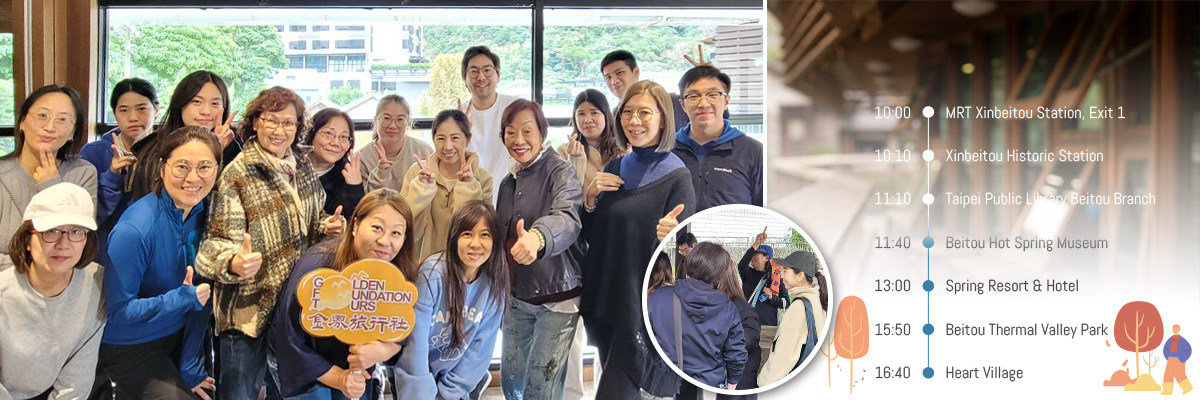
The 115th-Year Employee MRT Beitou Hot Spring One-Day Tour embraces energy conservation and carbon reduction while blending history, hot spring scenery, and gourmet delights. The journey begins at the Japanese-era wooden Xinbeitou Historic Station, where participants can experience the charm of a century-old railway station and enjoy the rare “green sulfur spring” hand bath at the nearby Xingchuan Pavilion. Next, visitors stroll to the forest-surrounded Beitou Library to admire Taiwan’s first eco-friendly green building and its beautiful wooden architectural design. Right beside it is the red-brick Beitou Hot Spring Museum, where guests can explore the glorious history of Beitou’s public bathhouse culture.
At noon, the group will enjoy an exquisite and abundant lunch at Spring City Resort. After the meal, the tour continues to the misty Thermal Valley, where visitors can witness the dreamlike emerald-green sulfur spring source. Finally, the tour concludes at Zhongxin New Village, Taiwan’s only hot spring military dependents’ village, where participants can experience the nostalgic atmosphere and everyday charm of traditional military village life. This enriching journey of culture, nature, and relaxation ends on a perfect note.
Take a bird's-eye view from the heavens and re-examine the very land we call home! Nestled at the far end of Tamsui Old Street, behind the historic Douglas Lapraik & Co. building, lies a sanctuary where one can find inner peace and witness the grandeur and beauty of Taiwan: the Chi Po-lin Space. More than just a collection of Director Chi’s lifelong dedication, this space serves as a window opening into the sky.Our walking tour invites you into this unique venue, where a historic trading house seamlessly blends with modern visual aesthetics. Through a series of breathtaking, large-scale aerial photographs, we will follow the wings of Director Chi to gaze down upon Taiwan’s majestic mountains, vast oceans, and the intricate contours of the land sculpted by time.
Here, beauty and melancholy coexist. As we marvel at the unparalleled splendor of Taiwan, we are also brought face-to-face with the raw scars left by environmental development. This journey is far more than a visual feast—it is a deeply moving baptism of environmental aesthetics that touches the soul.

